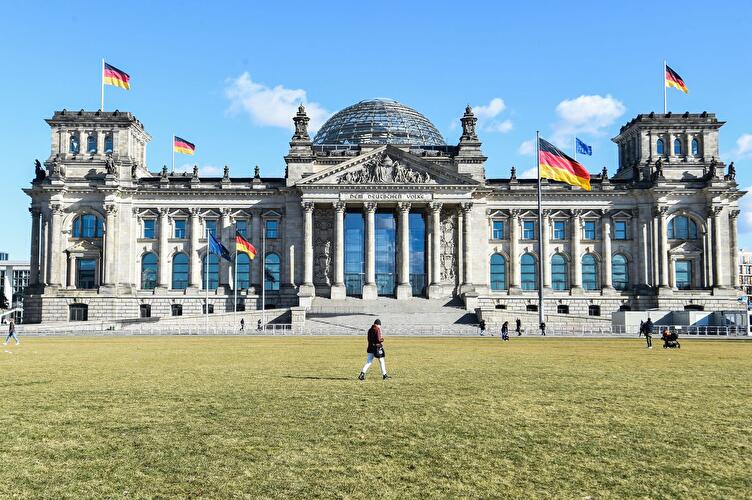
There are 3 main branches of the federal government in Germany: Executive, Legislative, and Judicial.
- Executive Branch:
- Federal President of Germany:
- Current President: Frank-Walter Steinmeier, 2017-present
- Election: The Federal President of Germany is chosen by the Federal Convention, which usually meets once every 5 years to elect a new president. Its only function is to elect the president and is composed of members of the State Diets and the Federal Diet. Presidential candidates are proposed by members of the Federal Convention and must be 40 years old and a German citizen. They are elected through secret ballots and must win the majority of the vote. If not, a runoff election is held. If needed, a third election may be held where candidates only need to win a plurality of the vote. The President may only serve 2 terms.
- Roles and Responsibilities: The Federal President is head of state and represents Germany domestically and internationally. The president signs treaties and appoints and receives ambassadors. The president also formally appoints and dismisses (if necessary) the Federal Chancellor, dissolves the Bundestag, signs laws, and appoints federal judges, federal govenment officials, and members of the Armed Forces. The President can also pardon individuals and issue honors.
- Federal Chancellor of Germany:
- Current Chancellor: Olaf Scholz, 2021-present
- Election: The Chancellor is proposed by the Federal President and elected by the Bundestag, without debate (no discussion, just voting). The candidate must receive an absolute majority of the votes. If this is not achieved, a second round of voting is held with another candidate. If an absolute majority is not achieved, a third election is held wherein the candidate with the most votes wins. After election, the Federal President must formally appoint the Chancellor within 7 days or dissolve the Bundestag, forcing new elections.The Chancellor typically serves from appointment until a new Bundestag convenes, but may be removed in case of a vote of no confidence and simultaneous election of a sucessor by the Bundestag. This has only occurred once, in 1982.
- Roles and Responsibilities: The Federal Chancellor is the head of government in Germany and the commander-in-chief during wartime. The Chancellor proposes cabinet appointments, who are approved by the Federal President and may also propose dismissals of cabinet members (must be approved by Federal President). The Chancellor is the head of and oversees the Cabinet. The Chancellor sets guidelines for government action. The Federal Ministers can execute policy for their individual departments as they see fit as long as it fits the guidelines set by the Chancellor. The Federal Chancellor also appoints a deputy, generally a Federal Minister, and can propose dissolution of the Bundestag (must be approved by Federal President).
- Cabinet: The Federal Cabinet of Germany consists of the Federal Chancellor of Germany and cabinet ministers. It is the main exexutive body in Germany and is responsible for day-to-day functioning of the government. It meets weekly to discuss policy and make decisions and is chaired by the Federal Chancellor, who appoints the ministers. Chancellor appointees are approved by the Federal President. Each minister is responsible for an individual department and related affairs.
- The Legislative Branch:
- Federal Diet (Bundestag): The main legislative body of the German federal government. Elections of members of the Bundestag are held every 4 years in direct elections where every German citizen 18 or older can vote for candidates. Around half the representatives are elected via first-past-the-post single-member districts and the rest via party-list proportional representation. The Bundestag creates legislation, decides the federal budget, deploys the Federal Armed Forces, elects half the members of the Supreme Court, and appoints the Federal Council.
- Federal Council (Bundesrat): The Bundesrat represents the interests of the various states in the federal government. It links the states to the Federal Government. The Bundesrat reviews bills and EU regulations, must approve certain types of bills ("consent bills", which directly involve state interests and those that amend the constitution), may object to other bills with the possibility of an override, introduces bills to the Bundestag, offers consent on certain governmental actions, and elects hald the members of the Supreme Court.
- The Judicial Branch:
- Federal Constitutional Court (Supreme Court): The Federal Constitutional Court ensures that German law adheres to the Constitution (the "Basic law") and rules on cases that involve conflict regarding the Basic law. It has the power of judicial review and may declare legislation unconstitutional. It consists of 2 Senates with 8 justices each. The President presides over the first Senate, the Vice-President over the second. Half the justices and either the President or the Vice-President are elected by the Bundestag, and the other half and the President or Vice-President (They take turns) are appointed by the Bundesrat. Justices serve up to 12 years or until the age of 68, whichever comes first, and they cannot be re-elected.
In addition to the federal government, Germany also has regional governments, one for each of its 16 states. These states are:
- Baden-Württemberg,
Capital: Stuttgart
- Bavaria (Bayern),
Capital: Munich (München)
- Berlin
- Brandenburg,
Capital: Potsdam
- Bremen,
Capital: Bremen
- Hamburg
- Hesse (Hessen),
Capital: Wiesbaden
- Lower Saxony (Niedersachsen),
Capital: Hanover (Hannover)
- Mecklenburg-Vorpommern,
Capital: Schwerin
- North Rhine-Westphalia (Nordrhein-Westfalen),
Capital: Düsseldorf
- Rhineland-Palatinate (Rheinland-Phalz),
Capital: Mainz
- Saarland,
Capital: Saarbrücken
- Saxony (Sachsen),
Capital: Dresden
- Saxony-Anhalt (Sachsen-Anhalt),
Capital: Magdeburg
- Schleswig-Holstein,
Capital: Kiel
- Thuringia (Thüringen),
Capital: Erfurt
Voters in these regions elect representatives to their State Diet (one for each state), which elects the Minister-President of the state (serves on the Federal Council) and oversees legislation on a state-level. States also have their own regional courts.